Farm-Fresh FAQ
Answers to your questions about local farms, CSAs, farmers markets, and buying farm-fresh food near you
Find answers to the most common questions about finding local farms, joining CSA programs, visiting U-pick orchards, shopping at farmers markets, and supporting small family farms near you. Click any question to expand the full answer.
Finding Farms Near You
- Q How do I find local farms near me?
-
Use the FarmLists.org search to enter your zip code or browse by state to find small family farms near you. You can filter by farm type — CSA programs, farmers markets, agritourism, on-farm markets, or food hubs — to find exactly what you're looking for. Our directory covers over 10,000 farms across all 50 states.
- Q What is the best time of year to visit a farm?
-
The best time depends on what you're looking for. Spring brings asparagus, strawberries, and farm stand openings. Summer is the most abundant season — tomatoes, sweet corn, peaches, blueberries, and the full range of farm market produce. Fall is the most celebrated farm visit season — apple orchards, pumpkin patches, corn mazes, and cider pressing all peak in September and October. Winter visits are quieter but root vegetable farms, greenhouse operations, and year-round farm markets are active. For specific crops, the FarmLists.org blog publishes seasonal produce guides by state so you can time your visit to what's actually at peak.
- Q Can I visit a farm without an appointment?
-
It depends on the farm type. U-pick farms, on-farm markets, and farm stands generally welcome walk-in visitors during their posted hours. Agritourism operations like farm tours, farm dinners, and workshops typically require advance reservation. CSA farms are usually not open to walk-in visitors outside of scheduled pickup times. Always check the farm's listing on FarmLists.org or contact them directly before visiting — farm operating hours are seasonal and can change without notice, and showing up unannounced at a working farm that isn't expecting visitors can be disruptive to the farm's operations.
- Q How do I find farms near me that accept SNAP EBT?
-
Search FarmLists.org by your state or zip code and look for farmers markets and on-farm markets in your area. Contact the farms or markets directly to confirm SNAP acceptance — many have updated their payment options in recent years. The USDA's SNAP Retailer Locator is also a useful resource for finding authorized SNAP retailers including farmers markets near you. If your local farmers market doesn't currently accept SNAP, contacting the market manager about adding it is worth doing — many markets are actively working to expand SNAP access.
- Q What are the benefits of buying directly from small farms?
-
Buying directly from small farms gives you fresher, more flavorful food harvested at peak ripeness. It supports the financial viability of family farms — more of your dollar goes directly to the farming family. It gives you transparency about how your food was grown. It connects you to the seasonal rhythms of your local food landscape in a way that grocery shopping cannot. And in aggregate, it helps maintain the farmland, agricultural knowledge, and ecological diversity that industrial farming has steadily eroded.
- Q Are farm products more expensive than grocery store products?
-
Farm-direct prices are sometimes higher than grocery store prices for the same item, and sometimes lower — it depends on the product, the farm, and the grocery store. Staple vegetables at peak season from an efficient small farm are often competitively priced with grocery alternatives. Pastured meats, specialty cheeses, and heirloom varieties typically cost more than commodity grocery equivalents because they're produced with more care and labor. The value comparison is also more nuanced than price alone — the quality difference between a farm-fresh tomato at peak season and a grocery store tomato is substantial.
CSA Programs
- Q What is a CSA program?
-
CSA stands for Community Supported Agriculture. You pay a farm upfront — typically at the beginning of the growing season — for a regular share of their harvest, delivered weekly or bi-weekly throughout the season. A CSA share usually contains a mix of seasonal vegetables, herbs, and sometimes eggs, fruit, or flowers. The arrangement supports the farm financially before the season begins and gives you a direct connection to the food you eat and the farmer who grows it.
- Q How much does a CSA share cost?
-
A standard weekly vegetable share typically ranges from $20 to $35 per week, paid as a lump sum at the beginning of the season or in installments. Smaller or half shares are often available for individuals or smaller households. Some farms also offer meat, egg, dairy, or flower add-on shares. Many farms offer payment plans, sliding scale pricing, or work-share arrangements for those with financial constraints.
- Q When should I sign up for a CSA?
-
Most CSA programs open enrollment in late winter or early spring — January through March — for a season that typically begins in May or June. Popular programs fill up quickly, so signing up as early as possible is advisable. Some farms have waitlists for the following season. Fall and winter CSA programs exist for farms that continue production into colder months, and these typically enroll in late summer. Check the farm's listing on FarmLists.org or contact them directly to confirm their enrollment timeline.
- Q What if I don't like something in my CSA box?
-
Most CSA programs give members some flexibility — many farms allow you to swap items you don't want for extras of something you prefer. Some programs offer customizable shares where you can indicate preferences. If you consistently receive something you can't use, talking directly with the farmer is always the best approach — most are happy to work with members to maximize the share's value. The key is to communicate early in the season rather than letting unused produce go to waste.
- Q What should I know before joining a CSA for the first time?
-
Before joining a CSA, clarify the pickup location and schedule — weekly pickups are a commitment. Understand what the share typically contains and whether the farm offers customization options. Consider starting with a half share if you're unsure whether you can use a full share each week. And mentally prepare for the learning curve — the first few weeks involve cooking with vegetables you may not have prepared before, which is part of the experience and the value.
- Q How do I find a CSA near me?
-
Browse the FarmLists.org directory by your state or zip code and filter by CSA Programs to see options near you. Each CSA listing includes contact information, enrollment details, and a description of what the share typically includes. Because CSA programs fill quickly — often before the growing season begins — it's worth identifying two or three programs near you and contacting them in late winter or early spring to ask about enrollment.
Farmers Markets
- Q What should I bring to a farmers market?
-
Bring reusable bags or a basket for your purchases. Cash is useful since not all small farm stands accept cards, though most larger markets have card readers now. Arriving early gives you the best selection, especially for popular items like fresh bread, pastured eggs, and specialty produce. Bring a cooler or insulated bag if you're buying meat, dairy, or anything that needs to stay cold. Most importantly, come with time to talk — the conversation with the farmer is part of what makes farmers markets worth visiting.
- Q Do farmers markets accept SNAP EBT?
-
Many farmers markets now accept SNAP EBT cards. Markets that accept SNAP typically have a central token booth where you exchange your EBT balance for tokens usable at participating vendors. Some markets participate in Double Up Food Bucks or similar matching programs that double the value of SNAP spending on fresh fruits and vegetables. Check with your local market before visiting to confirm SNAP acceptance, as participation varies by market.
- Q What is the difference between a CSA and a farmers market?
-
A CSA is a subscription commitment to a single farm's seasonal harvest — you pay upfront and receive whatever the farm grows each week. A farmers market is a weekly gathering of multiple farms and food producers where you buy what you want with no advance commitment. CSAs offer a deeper relationship with one farm and guaranteed weekly produce, while farmers markets offer flexibility, variety, and the ability to choose between multiple farms. Many local food enthusiasts do both.
- Q How do I know if a farmers market is legitimate?
-
Legitimate farmers markets have a defined vendor application process and require vendors to sell products they've grown or produced themselves. Signs of a well-run market include consistent vendor attendance, seasonal variety (not everything available year-round at peak quality), and farmers who can answer detailed questions about their growing practices. When in doubt, ask vendors directly where their products were grown — farmers who grow their own food are generally happy to talk about it.
- Q What is the difference between a farm stand and a farmers market?
-
A farm stand is operated by a single farm, selling only that farm's own products, typically on or near the farm property. A farmers market is a gathering of multiple farms and food producers in one location, giving shoppers access to variety from many operations in a single visit. Farm stands often have the freshest possible produce since items are harvested that morning, while farmers markets offer diversity and the social experience of a community gathering. Both are excellent ways to buy directly from small farms.
U-Pick Farms & Agritourism
- Q What is a U-pick farm?
-
A U-pick farm is an operation where you harvest your own produce directly from the field or orchard, paying by weight or volume for what you pick. U-pick is most common for berries (strawberries, blueberries, raspberries), apples, peaches, pumpkins, and Christmas trees, though some farms offer U-pick for vegetables, flowers, and herbs. U-pick farms generally offer lower prices than farm stands because you provide the harvest labor, and the experience of picking your own food is part of the appeal.
- Q What should I bring to a U-pick farm?
-
Wear comfortable clothes you don't mind getting stained — berries in particular will leave their mark. Closed-toe shoes are important for walking through fields and orchards. Most U-pick farms provide containers for picking but calling ahead to confirm is worthwhile. Bring sunscreen, a hat, and water especially for summer visits. Arrive early in the day for the coolest temperatures and best fruit selection, and check the farm's website or social media before visiting to confirm the crop is ready.
- Q When is strawberry U-pick season?
-
Strawberry U-pick season varies significantly by region. In the South — Louisiana, Florida, South Carolina — strawberries ripen as early as January and February. In the Mid-Atlantic and Midwest, peak season is typically late May through June. In New England and the upper Midwest, strawberries peak in late June and into July. The season at any given farm is typically two to four weeks long. Check with farms directly or follow their social media for harvest updates.
- Q What is agritourism?
-
Agritourism refers to farm-based experiences that welcome visitors — anything from U-pick orchards and corn mazes to hayrides, farm tours, farm dinners, agricultural workshops, and overnight farm stays. Agritourism gives families direct contact with working farms and the people who run them, and provides farms with an important revenue stream beyond their primary production.
- Q Are agritourism farms good for kids?
-
Yes — agritourism farms are among the best family outing options available, particularly for children with limited exposure to where food comes from. Picking apples directly from a tree, feeding animals, navigating a corn maze, or riding a hayride provides hands-on learning that classroom environments can't replicate. Most agritourism farms are designed with families in mind. Check the farm's listing for age recommendations and any restrictions — some events like farm dinners are adult-oriented while U-pick and harvest festivals are typically all-ages.
- Q Are there farms near me that offer farm dinners or farm-to-table events?
-
Farm dinners — meals prepared and served on the farm using the farm's own produce — have become a popular agritourism experience across the country, ranging from casual picnic-style dinners to formal multi-course events. Search FarmLists.org by your state and browse agritourism listings to find farms that offer farm dinners and events, and follow farms on social media for announcements of specific events — farm dinner dates often sell out quickly.
On-Farm Markets & Food Hubs
- Q What is an on-farm market?
-
An on-farm market is a retail stand or store located directly on the farm property where customers can buy the farm's products at the source. On-farm markets range from simple roadside stands to full farm stores with refrigerated sections, value-added products, and extended hours. Buying at an on-farm market means the maximum share of your purchase goes directly to the farming family, and you often get access to products that don't appear at farmers markets or in stores.
- Q What is a food hub?
-
A food hub is an organization or business that aggregates locally produced food from multiple farms and distributes it to multiple buyers — households, restaurants, institutions, or retailers. Food hubs make local food more accessible by reducing the logistical burden on individual farms and buyers. For consumers, a food hub might offer a weekly farm box sourced from multiple farms, or operate a retail location carrying products from dozens of local producers.
- Q Do small farms near me sell online?
-
Many small farms now offer online ordering for CSA shares, farm boxes, and individual products. Some farms use their own websites, others use platforms like Local Line, Barn2Door, or FarmersWeb. Check the farm's individual listing on FarmLists.org or visit their website to see current online ordering options. Online ordering is most common for CSA share enrollment and pre-orders for specific products like pastured meats where customers want to reserve items before they sell out.
Farming Practices & Labels
- Q What is the difference between pasture-raised and grass-fed?
-
Pasture-raised describes how an animal was raised — with meaningful access to outdoor pasture. Grass-fed describes what the animal ate — a diet of grass and forage rather than grain. An animal can be pasture-raised but finished on grain before slaughter, which changes the fat profile of the meat. Grass-fed and grass-finished means the animal ate only grass its entire life. For the most transparency, ask the farmer directly — small farm operations typically know the details of their animals' diet and living conditions.
- Q What is the difference between organic and regenerative farming?
-
Organic farming is a certified standard regulated by the USDA that prohibits synthetic pesticides, synthetic fertilizers, and GMOs. Regenerative farming is a broader philosophy focused on actively rebuilding soil health, increasing biodiversity, and restoring ecosystem function through cover cropping, no-till cultivation, and rotational grazing. A farm can be regenerative without being certified organic, and certified organic without being regenerative. Many small family farms practice regenerative methods without pursuing organic certification because the certification process is costly for small operations.
- Q What does it mean when a farm says they use regenerative practices?
-
When a farm describes itself as regenerative, they're typically referring to methods that rebuild soil health — cover cropping between production cycles, minimizing tillage to preserve soil structure, integrating livestock into crop rotations, and managing land in ways that increase organic matter and biological diversity over time. Unlike organic certification, there's no single official certification for regenerative farming, which means the term is used broadly. Asking the farm specifically which practices they use is the best way to understand what regenerative means on their operation.
- Q What is the difference between free-range and pasture-raised eggs?
-
Free-range is a USDA-regulated term indicating that poultry had outdoor access, but the duration, quality, and size of that outdoor space is not specified — a small door to a concrete pad technically qualifies. Pasture-raised means the birds had meaningful access to actual pasture for grazing, typically defined as at least 108 square feet per bird. Pasture-raised eggs from small farms are a meaningfully different product — higher in omega-3 fatty acids, richer in color, and produced by hens whose lives more closely resemble their natural behavior. Ask the farm directly about their outdoor setup if you want to know the specifics.
Seasonal Produce
- Q Why does farm-fresh produce taste better?
-
Farm-fresh produce tastes better primarily because of timing. Most grocery store produce is harvested before peak ripeness to withstand shipping and storage, sometimes traveling thousands of miles over days or weeks before reaching a shelf. Farm-fresh produce is harvested at or near peak ripeness and consumed within hours or days. At peak ripeness, sugars are at their highest and the cellular structure that gives produce its texture hasn't degraded. A strawberry picked that morning and a strawberry that spent a week in a refrigerated truck are technically the same fruit but taste nothing alike.
- Q What is the best way to store farm-fresh produce?
-
Storage varies significantly by item. Tomatoes should never be refrigerated — cold temperatures break down the compounds that give them flavor. Greens should be stored in the refrigerator wrapped loosely in a damp cloth inside a bag. Herbs do well stored like flowers — stems in water on the counter. Root vegetables last longest in a cool, dark place. Berries should be refrigerated and eaten within two to three days. Stone fruits are best stored at room temperature until ripe, then in the refrigerator. If you receive CSA produce you can't use immediately, blanching and freezing preserves the harvest effectively.
- Q What are heirloom vegetables and why do farmers grow them?
-
Heirloom vegetables are open-pollinated varieties that have been cultivated and seed-saved for generations — valued for flavor, genetic diversity, and cultural heritage. They're generally unavailable in commercial supply chains because they were selected for taste rather than the shelf life and uniformity that industrial agriculture requires. Small farms grow heirloom varieties because their customers appreciate the superior flavor, because maintaining genetic diversity in food crops is ecologically important, and because some heirlooms carry regional agricultural heritage worth preserving.
About FarmLists.org
- Q What types of farms are listed on FarmLists.org?
-
FarmLists.org lists five types of small farm operations: CSA programs, farmers markets, agritourism farms (U-pick, corn mazes, farm tours, farm stays), on-farm markets (farm stands and stores located on the farm property), and food hubs (operations that aggregate and distribute locally produced food from multiple farms). All listings are independently owned small family farms that sell or provide experiences directly to consumers. Large commercial agribusinesses are excluded by design.
- Q How do I list my farm on FarmLists.org?
-
If you operate a small, independent family farm and sell or provide experiences directly to consumers, visit the Advertise with FarmLists page or contact us directly. Basic listings are free for qualifying farms. Premium listing options are available for farms that want enhanced visibility on state and city pages and priority positioning in search results. We review all submissions to ensure they meet our criteria for small, independent, direct-to-consumer farm operations.
- Q How can I support small farms beyond buying their products?
-
Buying directly from small farms is the most impactful thing you can do, but other meaningful ways to support them include leaving a Google review, sharing their social media posts, tagging them when you visit, and referring friends and family — especially first-time farm visitors. Joining a CSA provides the farm with upfront capital before the season begins, which is often when cash flow is tightest. And simply showing up consistently as a loyal customer, rather than only when it's convenient, is what sustains farm businesses through the long term.
Your Local Farm-Fresh Food Roadmap
Discover the right-for-you farm resources in your own back yard
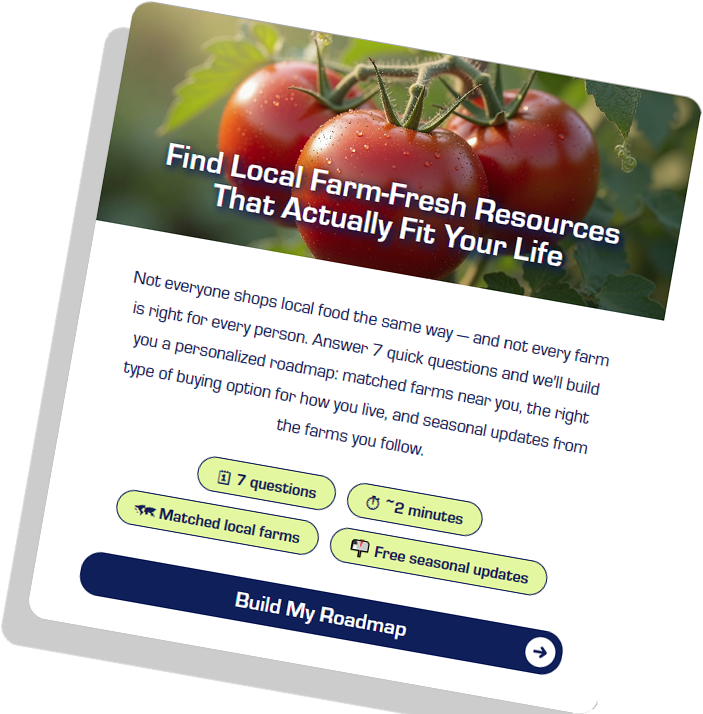
Not everyone shops local food the same way - and not every farm is right for every person.
Answer 7 quick questions and we'll build you a personalized roadmap: matched farms near you, the right type of buying option for how you live, and seasonal updates from the farms you follow.